John Singer Sargent - An artist in his studio (1904). Oil on canvas
"There’s this painting that I always keep with me, always. It's one of those little postcards reproductions. I've even made a gold frame for it out of balsa wood. The painting is called "The painter in his studio" and is by John Singer Sargent. The painting depicts a man painting a picture in his studio but his studio is not an artist studio but is the artist's home .. the man has the painting proped up on the bed in the bureau, there is no easel. You get the idea that the only things in the room are the bed, the bureau and the chair upon which the man sits. Much of this composition is given over to laundry and rumpled bed linens. The man is confined to extremely small quarters, the setting is grim and it contrasts with the painting that the man is working on, a landscape. Horses meander through a soft green medow, the trees are lush and full and the blue horizon is dotted with clouds.
Most Sargent comentators dismiss this painting they consider it to be nothing but a silly joke, an artist painting a landscape in his crammed dullful bedroom, but I consider this painting to be a masterpiece because it captures the idea that through art man is able to transcend his dismall small surroundings.
This painting is not a joke, this artist is not painting a landscape. This artist is painting a window.
Look out this window for a moment, you'll find the view is brathtaking. I've spent my entire life looking for the way to get to the other side of this window. I've been told time and time again that I'm wasting my efforts but I've never given up. I've always known that there is a way to break the glass and crawl out over the window-sill, I've always been certain of it and I've made a vow that I'll never give up."
When out of exhaustion all you can pour on your exam is a nebula of approximative concepts.
When your head feels turgid and your eyes are sore.
When your shoulders feel you are carrying the world on them.
When your legs are weakened and your complexion weary.
It takes the breeze in your face while cycling back home,
the warm golden sunbeams of early spring
that makes Paris gleam
or just a kind bearded smile and a wave
from behind a windshield,
to remind you
It was the best of times, it was the worst of times, it was the age of wisdom, it was the age of foolishness, it was the epoch of belief, it was the epoch of incredulity, it was the season of Light, it was the season of Darkness, it was the spring of hope, it was the winter of despair, we had everything before us, we had nothing before us, we were all going direct to Heaven, we were all going direct the other way--in short, the period was so far like the present period, that some of its noisiest authorities insisted on its being received, for good or for evil, in the superlative degree of comparison only.
We are made not only of what we did and accomplished. We’re also made up of all the things we discarded, all the things we failed to do, all the things we did not dare do. That’s part of us. All the things you renounced. The woman you didn’t marry. The woman who said, ‘No, I don’t love you’.
Javier Marias, “The Full English” by Robert Collins, The Sunday Times Feb. 14th, 2016
While
the interviewer seems to be trying to lead Mr. Edwards to say he is
now out of a job as a royal photographer, Edwards has nothing but
kind comments towards Kate Middleton and goes on to praising the
Duchess' skills.
The
end result is a small triumph of domestic photography, just a mother
sharing a picture of her baby. What could be an ordinary daily life
moment has wider connotations.
When
the journalist suggests Mr. Edwards might be out of the job, he
answers « not until she starts catching planes and taking
pictures of the royals around the globe » implying he's still
the one in charge of immortalizing that kind of events. Maybe they
won't need him indoors to take the family portraits anymore but he
still does and covers the official visits as well as the
domestic events – their births (besides their baby pics), deaths
and marriages
The journalist says « your job will be in public
places » as if he were trying to redefine his job already.
Historically
and traditionally those with direct access to the prince or the
royals in general benefit of social and political status. To
be appointed to the staff of the chamber of the King was a sign of
great privilege and assured high rank. The royal painter was
included among these valets
de chambre
and they would swear an oath to serve loyally. This closeness to the
king and the access to his intimacy was a great honor for artists and
would propel the career of a common artisan to the highest possible
step of the ladder. I can think of artists such as Jan Van Eyck,
Leonardo da Vinci, Michelangelo, just to name a few. All held at one
point in their careers a position at court. But since it's the
picture of baby Charlotte that made the buzz, I can't help but think
of Diego Velazquez's famous painting entitled « Las Meninas » where
the Infanta Margarita or Infant Margaret is surrounded by all her
courtesans preparing her to be portrayed.
But
even without going back so much in time, in this very same interview,
Mr. Edwards talks about his relationship to Diana and how it was him
the one in charge of the intimate family portraits.
The
Brits love their royals and the media machine that surrounds the
Windsors has become as much of a British institution as the Royal
Family themselves. They went from distant beings dressed in velvet
and sitting in thrones to being celebrities. We would all recognize
any member of the family if they drove past but this was of course
not the case not that many generations ago. The Palace would have to
print portraits of the monarchs so people would know who to cheer.
Since the invention of photography it then became the norm for a
camera to accompany the King or Queen on every royal walk, especially
when they were meeting with ordinary people. I believe that showing
the public the King's daily duties helped to justify the British
monarchy at a time when most of Europe was getting rid of it.
Edwards
talks with affection of the family as if he were part of it. He saw
the princes grow in front of his camera lens and now it's the
grandchildren that get to be portrayed by someone else... their
mother, for that matter. He doesn't seem worried that his heyday as
the royal photographer is behind. He has been loyally serving for many
decades and he shouldn't be far from retirement. But his successor's
job description will certainly be modified.
Nowadays
we can all do a photo-portrait, a practice historically limited to
only a few . You no longer have to be a professional photographer to
take portraits: Everybody
is a photographer
The
camera used to be a way of conveying truth and recording a memory
while representing a symbolic appropriation or selection of the
world. Now this art has evolved drastically as to include digital
retouching, filtering and all sorts of different methods to enhance
reality.
But
as the journalist himself puts it, it's not so much the fact that the
Duchess has taken a picture -as she probably takes thousands of them-
but that she's shared it. Even the more artistic, less special
event-driven kind of photography that used to be reserved for
hobbyists is now democratized by photo-sharing apps like Instagram
or, in this case, Twitter as it was the official Kensington Palace
Twitter account the one that first published the pictures. So it's
not only the fact that we can all take any kind of picture with the
ubiquity of mobile photography, but that they can also be shared
without any further effort.
Mr
Edwards compliments Kate Middleton's photographic talent and says
that despite « SOME technical imperfections the pictures are
just brilliant « .
The
decisive moment, Cartier-Bressons' staple style, has lost relevance
as now digitally manipulated images can render almost any effect.
Composition and exposure are less of a skill as everything can be
cropped, deleted, added or in every way modified. Just by clicking on
any of the dozens of filters Instagram has to offer, we can add that
romantic vintage look that, paradoxically, analog pictures have.
What
are those « technical imperfections » Edwards talks
about ? Or is he just saying that to make the point they weren't
taken by a professional?.
The pictures seem more than acceptable
to me, have you ever tried to shoot a 6 month old baby ?. That
leaves me to question what's the difference between a professional
and an amateur shot when now we can all have access to the same
high-end cameras and post processing tools. While the answer exceeds
the limits of this presentation I can't help but wonder how this art
is changing in an online visual world. Could it be that being a
professional photographer at the present time is only about the
privilege of being in the front bench of events ?.
« Tell
her to carry on » he says. “You’ve
just got to adapt, you’ve just got to accept, and still find
something to do every day,” Mr Edwards tells presenter Justin Webb.
Aware of the changing nature of his profession.
To us foreigners the British monarchy appears as a thing from the past and its continued existence is somewhat a mystery. Despite the prestige of the institution being slightly deteriorated in the last decades and its very existence questioned, it is generally felt that the monarch and the Royal Family play an important role in society. They are regarded as role models (this is especially the case for the Queen Mother and Princess Anne, maybe less so for Charles even though Princess Diana is still massively loved) and they are the image of a perfect united family. They are actively involved in charity work, they are the image of unity and morality.
The new
generation of royals (Prince William and Harry) are seen as being
down-to-earth regular guys. The Duchess of Cambridge is supposedly
one of us. The future queen is every fashion magazine coveted
cover-girl and the girl next-door who married a prince. They are
seemingly ordinary and likable and not the unattainable semi-gods
that they once were. Equally, George and Charlotte are the babies of
the nation and everybody
feels entitled to say how much the boy looks like his father or make
a remark about the the baby girl's smile. Gone are the days of
oppression and tyranny. These babies grow up in front of our eyes as if they were art of our own family.
The
pictures of Princess Charlotte that were shared show a regular baby,
dressed in regular baby clothes (a Liberty dress and a posh little
cardie) playing with a stuffed dog. Nothing particularly fancy or
royal about the picture composition. Maybe this is also another way
of justifying the monarchy: showing us that we're not all that
different after all.
In
a period when protest music wasn't common, Billie Holiday does a live
performance of « Strange Fruit » in a theater or
nightclub. Although we cannot see the public in
the footage, we can guess that the audience was probably not an
exclusive black one. In a 1939 America where racial equality is
almost nonexistent, Billie Holiday sings a heartbreaking ballad and
we can feel the grief she sings it with. She sings her story, the
suffering of her people. She wouldn't have believed that 16 years
later, jazz was going to become America's music.
Penny Von Eschen's excerpt of the book SatchmoBlows up the World : Jazz Ambassadors Play the Cold War describes the irony of what seems to be two opposed worlds : an
intrinsically unequal America and the jazz being the music chosen to
show artistic expression to the world. During Eisenhower's
Administration, in 1956 Dizzy Gillespie tours the world as the
goodwill ambassador of the US.
On the Road by
Jack Kerouac, father of the Beat Movement so immensely inspired by
jazz music. Kerouac's prose is characterized by a style submerged in
the stream of consciousness, words spoken out in bursts, in
onomatopoeia, sparsely punctuated as if by reading we were playing a
trumpet or a saxophone, taking fast breaths in order to carry on
reading. The excerpt describes the hectic atmosphere of a jazz club.
Throughout this comment I'll hint at how the same music can be
used as a protest, as propaganda and to « let it all out ».
Redemption Songs
« Strange
Fruit » is a cry against the atrocities of racism. When Billie
Holiday sings we get goosebumps because we feel her pain. She sings
this song wholeheartedly and almost as gospel. We barely hear the
piano play on the back, all we feel is the extreme sadness that
releases from this almost
a Capella ballad. The poem describes a very explicit scene of
lynching « Black bodies swinging in the southern breeze ».
The strange fruit is the one who's different, is the rotten fruit
that nobody wants to pick, left « for the crows to
pluck ». It's the « strange and bitter crop » that had to be killed in order to avoid spoiling the field.
Lynching
is a particular kind of felony, instead of killing the person on the
spot and getting rid of the body, leaving the corpse hanging from the
tree is a lesson -if that word could ever be used to describe that
kind of cruelty-, it's left there for the others to see, it's not a
crime but the opposite, it's justice. Its purpose is to maintain the
order, the supremacy of the white, to spread terror.
By
singing « Strange Fruit » Billie Holiday not only
denounces the system but she also break all barriers and codes by
performing live.
We can feel the sweat of the mad crowd yelling and dancing in Kerouac's jazzclub scene.
Music brings races together and in this nightclub « everybody
was rocking and roaring ». People were « tripping
and riffing » if I may use the slang of that time. They dance
in an altered state of consciousness, they are high on hope, on life,
on music.
There
is no past, only this present moment where « The behatted
tenorman was blowing at the peak of a wonderfully satisfactory free
idea ». No resentment, the musicians play for all. The
euphoric crowd is in a trance state « a six-foot skinny negro
woman was rolling her bones at the man's hornbell ». It's
a religious-like experience, it's exhilarating, it's relieving. « A
big fat man was jumping on the platform, making it sag and creak ». Dean « was rubbing his chest, his belly, the sweat
splashed from his face ». But it's not only redemptive
for the crowds but for the musicians as well : « The
tenorman jumped down from the platform and stood in the crowd,
blowing around ».
The
musician is expressing what the crowds are feeling, the sound of
their instruments put into music what cannot be expressed with words.
« they were all urging that ternoman to hold it and keep it
with cries and wild eyes », the sound of the trumpet,
like that of Satchmo's, is the repressed cry of resistance of an
entire people.
Gillespie's world tour carried the voice of African Americans :
« blackness and race operating culturally to project an image
of American nationhood ». Jazz is inclusive was the
message : « I'm black, I'm American and this is our
music ».
President
Eisenhower wanted to expose American culture abroad for the purpose
of demonstrating the benefits of freedom -and capitalism for that
matter- on artistic expression. Dizzy Gillespie was probably
the first official jazz ambassador but many names followed « In
the high profile tours by Louis Armstrong, Duke Ellington » and also Charlie Parker, Thelonious Monk, and many more.
Worldwide
audiences felt in this modern jazz -or Bebop as it was also known
when it contained a high degree of improvisation- something rebel and
indescribable that spoke for them. It wasn't only music; it became an
attitude towards life.
But
that leads me to questionwhy was this music chosen? How did such a
revolutionary rhythm came to be representative of a country whose
roots were puritan and deeply repressive?
The Glaring contradiction
« Why
did American policymakers feel for the first time in history that the
country should be represented by jazz ? » asks Von Eschen. Why would Eisenhower's Republican administration take an
international stand against racism while indoors the situation was
far from ideal ?.
In
the context of the Cold War and particularly at this very ideological
stage, propaganda against Soviet Communism was major. America needed
to show the world the benefits of the « free world and the free
market ». Nevertheless the racial issue was brought up as a
main concern in global forums. Convinced that cultural influence is
irrevocably linked to political and economic power, the Eisenhower
administration sponsored America’s leading jazz musicians’ tours
abroad as part of its cultural foreign policy agenda, while a young
Martin Luther King led the boycott to the bus company. « The
prominence of African American jazz artists was critical to the
music's potential as a Cold War weapon ». But as Von
Escher puts it, this double irony does not end there, « with
the stroke of a pen, this hitherto disreputable music- routinely
associated in the mass media with drugs and crime- suddenly became
America's music ».
Billie
Holiday sings a protest song, a call for justice for black people in
this theatre where the audience is probably not black. The public had
bought their tickets to listen to this beautiful black woman sing the
sorrows of her people. This is a live performance, an almost a
capella one, and we hear no sound in the room whatsoever. The song
generates discomfort among the audience that does not clap at the
end. In the final seconds we see a very fragile Billie Holiday
standing in front of a mute audience. A public who payed this black
woman to tell them what they don't want to hear. What could have
possibly go through her head during those seconds? Was she scared
that this could put an end to her musical career? How much courage
does it take to sing to a white audience a song about crimes
perpetrated by... white people, their fellow countrymen? And what
does an applause mean, does it celebrate the talent, does it support
the cause?
In
any case the stake was immense and she won. Almost 80 years later,
this song continues to deplore racial discrimination.
The protagonists of On The Roadare at a nightclub and it seems its a mainly black people one. We can almost
hear the music and see the frenetic public « Dean was
clutching his head in the crowd, and it was a mad crowd. » This two young men find their peers at this place, among the
African Americans. Their cry
for freedom is a different one but it perfectly resonates with that
of this black crowd and the black musicians. This rundown jazz club
echoes their need for non-conformity.
Kerouac describes the scene from inside instead of choosing an
omniscient voice and by doing so he takes the reader along and we all
merge with the crowd. There is no segregation, no classes, no
differences, we all let go of our identities, of our ethnicity,
there's only music... and humans.
The
essential role of African Americans in U.S. national culture
As
Von Eschen puts it, the Brown decision, the Gillespie tour and the
Montgomery bus boycott led by Martin Luther King « inaugurated
a new phase of the black freedom movement ensuring that jazz tours
and the modern civil rights movement would forever be joined ». Though of course the strategy was not intended as a promotion
of democracy led by black artists, this unique Cold War strategy
unintentionally demonstrated the essential role of African
Americans in U.S. national culture.
The
Eisenhower Administration, ironically enough, made the claim that
jazz was the most unique form of American culture. So not only does
this show that Gillespie's tour was designed to counter Soviet
propaganda but it also proves that by exporting jazz to the world,
the US wanted to reveal racial equality in action. « US
officials pursued a self-conscious campaign against worldwide
criticism of US racism ».
By
dehumanizing the black race, slavery in America managed to delete
fundamental traits of African culture but the remains blended in
with the local one. This led out to (if I may say so) a 3rd
culture, the African American one. American-born black people,
several generations along the line, feel as American as the European
immigrants. It is only natural that black people were so deeply
involved with the civil
rights movement. They are as American as everyone else on the
territory. They expressed their solidarity with all the struggles for
racial equality around the globe.
Billie
Holiday sings in a theatre and describes « a pastoral scene of
the gallant south » not quite as the audience would
picture it. She carries the voice of those silenced Americans to the
ears of the other America that, taken with her talent, wishes to
listen.
And
so is the case of Gillespie and the many other jazzmen that
followed : their talent opened doors and they became ambassadors
of a cause as well as of their own country. They sold «the
universal, race-transcending quality of jazz while depending on the
blackness of musicians to legitimize America's global agendas ».
Ever
since,
all over the world, America is associated with jazz, African American
culture, the land of freedom, opportunity and egalitarianism. That is
the image they project and the black population played a major role
in defining this picture.
And
is not surprising that Kerouac's protagonists go to this «sawdust
saloon », a negro jazzclub to find this urge for freedom
they are after. A place where everybody screams their hearts out,
literally « he drew breath and raised the horn and blew high,
wide, and screaming in the air ». The 2 young white men
know that the black cause calls their name, is appealing to them -in
a different way- but it speaks the same rebel language.
The
blackness and the American-ness cannot be dissociated.
Jazz
music has been playing on the background throughout this text as we
I had been shedding light on the crusade of the African American
population for equality and recognition. All things duly considered
it is still equally impressive that such a music can be used in so
many different ways but at the same time congregate different causes
under the same rhythm. Jazz music is unquestionably black, it
wouldn't exist without its African roots but neither without its
American branches. But it's a music that plays to everybody. Jazz
sells a dream. And America knew how to use it in its favour.
No sé si fue el acento, la voz monótona o las instrucciones repetidas una y otra vez.
No sé si fueron los ruidos provenientes de los caños de desagüe, sentir el temblor del metro bajo mis pies.
Quizás la penumbra, o el aire húmedo del subsuelo.
La posición estática o el cansancio.
Quizás fue un sueño.
Pero sentí el aire fresco en la cara, la suave caricia del sol de un día frío del otoño tardío. El cielo azul, casi igual que el del glaciar a mi izquierda. A lo lejos se escuchaban los rápidos, el azul-turquesa del río era aún más brillante rodeado de los troncos color canela de los arrayanes.
Y ahí estaba.
Mi papá.
Abrazando a mi hijita.
Seis años no impedían que ella apoyase su cabecita en el hombro de él.
Yo veía su nuquita, papá me miraba con una mirada tranquilizadora. No tenía anteojos.
Ella abandonaba su cuerpito en los brazos de su abuelo. Es evidente que no era la primera vez que se encuentran.
Dormía.
Las lágrimas empezaron a brotar de mis ojos y luego a rodar por mis mejillas. Yo seguía inmóvil.
Y, por primera vez, no me quedé con el desgarro de esta realidad de ausencia.
Por primera vez me quedé con una sensación de tranquilidad de ese maravilloso abuelo que sería, que hubiese sido…
Es muy extraño este período de congés maternité. Recién ahora entiendo el significado de la dulce espera. Es como un paréntesis en la vida mientras todo y todos continuan su ritmo normal a mi alrededor. Las primeras dos semanas estuve sumamente activa: hacía mi clase de yoga en casa todos los días e iba a practicar al estudio 2 o 3 veces por semana, iba a la pileta, a museos, exposiciones, a caminar, a encontrarme con amigos, acomodé y reorganicé nuestro departamento, hice mi valija para el hospital, seleccioné tu ropita entre las bolsas y bolsas que nos dieron y después la lavé, cociné...
A partir de la 3ª semana, me empecé a sentir mucho más pesada y me cuesta un poco caminar. Los ligamentos de la parte más baja del abdomen tiran mucho y el peso ya es muy importante. Ya salgo mucho menos y me busco actividades dentro de casa.
Estas son algunas de las cosas que hice mientras te esperaba, este último mes:
Por primera vez (¡en mi vida!) hice un arbolito de Navidad y la festejamos en casa (me gustaría que se convierta en una tradición y empezar a festejar con vos, no como en mi infancia)
Aprendí a hacer algunos origami
Estoy haciendo un curso de Design online
Cocino seguido
Vamos bastante al cine
En general, estoy de acuerdo con Séneca:
Le plus grand obstacle à la vie, c’est l’attente qui se suspend au lendemain et ruine l'aujourd’hui.Sénèque
(El obstáculo más grande a la vida es la espera que interrumpe el futuro y arruina el presente)
A pocas horas, días, semanas de que mi vida cambie radicalmente y de tener en mis brazos a nuestra bebé, las emociones son tantas que me es muy difícil plasmarlas en un texto coherente. Lo quise hacer a lo largo del embarazo pero me fue muy difícil. Tenía las ideas en mi cabeza pero al intentar expresarlas, no pude dar con nada demasiado lógico. ¿Será por eso que este estado roza con lo mágico o, por qué no, milagroso?. Sí, millones de años de evolución humana, la ciencia que descifró el genoma humano y los avances y descubrimientos diarios pero... que un ser se forme y crezca en el propio cuerpo y que luego se convierta en una persona, sigue siendo algo mágico. ¡Pobres hombres que no pueden experimentar este estado! La naturaleza nos hizo un regalo maravilloso a las mujeres, poder sentir a tu bebé crecer y moverse dentro tuyo es el regalo más fantástico que me hayan podido dar... además del de mi propia vida.
Estos casi nueve meses fueron un período de conciencia plena de mi presente, de quién soy, del mundo que me rodea. Un período de éxtasis, de sentido de la dirección, de fuerza.
En la modernidad, con las ideas feministas de la "liberación femenina", decir que una mujer se siente plena cuando da a luz es políticamente incorrecto, inaceptable. Respeto desde lo más profundo de mi ser a aquellas mujeres que deciden de forma consciente no tener hijos, admiro esa seguridad y honestidad hacia ellas mismas. ¿Por qué está mal decir que una mujer se siente completa cuando trae a otro ser a este mundo? ¿Por qué está mal que el instinto animal, el instinto más básico, nos gobierne?
¿Por qué las mujeres queremos ser madres? No sé si es entonces este instinto animal de reproducción, si las mujeres somos instrumentos de un Plan Universal, si lo hacemos inconscientemente para conformar el modelo socio-cultural establecido o si, a un nivel metafísico que me cuesta imaginar, son los hijos los que nos eligen como padres. No tengo la respuesta a una sola de estas preguntas pero sólo puedo estar segura de una sola cosa: hoy me doy cuenta que no podría sentirme plena si, al final de mi vida, no hubiese pasado por esta experiencia.
La experiencia de la maternidad no es un sentimiento anodino: nos confronta con nuestra imagen del mundo, con nuestra consciencia del presente y con la fuerza de la vida. Es una experiencia iniciática (y no tengo miedo de usar esta palabra) que nos va a enseñar el significado del amor incondicional. El embarazo me dio una sensación de fuerza insospechada (espero que en el parto también). Las sensaciones más profundas se exacerban, los instintos se despiertan.
Convertirse en madre es ser responsable de su propio cuerpo, estar a la escucha de las necesidades reales, es volverse autónoma. Es realmente crecer y madurar. Me siento, más que nunca, conectada a la Tierra, a un Todo, a las generaciones pasadas y futuras. Siento a la vez una enorme responsabilidad y un reconocimiento infinito hacia esta Naturaleza que me eligió como depositaria de fertilidad.
Y no olvido el rol del padre, del compañero, el rol masculino al lado mío, tan vital como el femenino. Nada puede existir sin su opuesto (es lo que me tatué hace años en mi tobillo izquierdo para tenerlo siempre presente). El rol del futuro papá es axial y fundamental. Es complementario al mío y no me hubiese embarcado en tal aventura sola (mi reverencia a las madres solteras -por opción o no- quienes tienen que asegurar ambos roles).
Mujer y Hombre complementarios en esta maravillosa aventura de la vida.
2 años y medio después sigo teniendo las mismas certezas y las mismas dudas... salvo una: nuestro bebé está en camino.
No fue fácil, desde que tomamos la decisión hasta poder concretarla, pasamos -pero sobre todo yo- por muchas etapas: entusiasmo, frustración, rabia, abandono, hartazgo.
El tratamiento no fue fácil de sobrellevar psicológicamente. Decidimos mantenerlo en secreto y no me arrepiento, era demasiado pesado para digerir como para, además de todo, tener que soportar las ansiedades ajenas. Pero lo hicimos, de a dos, aunque haya sido yo la que se pinchaba todos los días.
Y ¡bendita seas, medicina y los profesionales que la ejercen con tanta vocación! Yo que despotrico seguido contra los métodos ortodoxos alopáticos, mi vida y la de nuestra futura hija dependieron en gran parte de la ciencia.
Hija: ¡te esperamos, añoramos, soñamos tanto! Empezaste a existir en nuestras vidas en un momento de amor incondicional, confianza y apoyo. Ambos te quisimos siempre, desde antes de que seas. Te imaginamos, te anhelamos.
Las primeras semanas de tu existencia las pasamos en el hospital, fueron momentos muy difíciles, de superar límites, de desesperación y dolor físico que no me creía capaz de poder soportar. Pero lo hice, lo superamos, los tres juntos.
Fue lejos la experiencia de dolor físico más intensa que sentí en mi vida pero, si tuviese que volver a pasar por ella para saber que vas a venir, lo haría ahora mismo.
Desde las primeras horas fuera del hospital, empezamos a darnos cuenta que no te habíamos soñado, que en esos pocos milímetros de tamaño seguías existiendo. Poco a poco fuiste tomando forma, evolucionando, mi panza volvió a redondearse pero esta vez... de vida. Mi estado de bienestar fue -desde que salí del hospital hasta hoy- total. No tuve el más mínimo síntoma "clásico" del embarazo: no sé lo que es un mareo, una náusea... Vinieron los anuncios oficiales, las sorpresas, las lágrimas de emoción. Organizamos picnics en tu honor y cenas, la noticia fue recibida con genuino afecto y buenos deseos de todo nuestro entorno.
Desde un principio tuve la certeza de que eras nena. Si bien no tenía ninguna predilección por uno u otro sexo, sabía que eras mujer. Hacia principios del 4º mes pudimos comprobarlo.
Ya estamos en el 5º mes. Todavía no tenés nombre, no es fácil encontrar uno que sea pronunciable de forma similar en 3 idiomas.
Hace poquito empezaste a moverte, te siento en la parte más baja de mi abdomen. Tus burbujitas me llenan el alma de amor y las ganas de tenerte en brazos son cada vez mayores.
Te extraño seguido y cuento los días que faltan para la próxima ecografía para poder verte. No sé cómo hacen las madres "normales" que sólo tienen 3 ecos en todo el embarazo, ¡nosotros tuvimos decenas!.
Mi mesita de luz parece la góndola "puericultura" de la FNAC. Libros, artículos y revistas se apilan sin ningún orden particular. Quiero leer todo, saber todo, aprender todo. Aunque sé que la mayor parte es instintivo y que no se aprende, quiero estar lo más preparada posible.
Pronto empezamos el otoño, vos nacerás al principio del invierno, aunque en las tierras de tu mamá será verano.
El papá y la mamá que te tocaron te cuidan desde ya y prometen hacerlo toda la vida, prometen dar lo mejor de ellos para vos, siempre. Prometen enseñarte todo lo que saben y aprender cosas nuevas juntos, en una nube de idiomas y culturas diferentes. Te dirán palabras, te contarán cuentos y cantarán canciones en distintos idiomas pero con el mismo amor.
Crecé sana en mi panza y descansá que la maravillosa aventura de la vida te espera.
Te esperamos, hijita, ¡te esperamos de brazos abiertos!
Crearon un mundo marcado por los sueños y el misticismo. Por una religión alternativa, por el exotismo y el erotismo, por el onirismo, el universo de la poesía y del arte simbolista. Una exacerbación de la sensualidad, la figura femenina, las líneas de la naturaleza y todos sus elementos. Desarrollaron una nueva lógica donde quedaron excluidos los valores tradicionales.
El apogeo del Art Nouveau fue muy efímero (de 1895 a 1905) pero marcó -y sigue marcando- una era y, sobre todo en París, es imposible no encontrarse cara a cara con vestigios de este maravilloso movimiento artístico.
El Art Nouveau es un arte esencialmente urbano del cual París sea posiblemente la capital (sobre todo después de la Exposición Universal de 1900), pero también se encuentra en ciudades como Barcelona, Glasgow, Viena, Bruselas y Riga.
Castel Béranger (1895-98) de Hector Guimard, 14, rue La Fontaine, XVIème - Paris
Cartel de la rue Agar en el arrondissement XVI de París
Detalle de una ventana de la rue Agar - XVIème - París
Entrada del metro Porte Dauphine - H. Guimard
Metro Abbesses - XVIIIème - Paris
Metro Chardon Lagache - XVIème - Paris
Detalle de un edificio Av. de Messine - París - Arquitecto Lavirotte
Puerta del 29, Av. Rapp, París - Arquitecto Lavirotte
Techo del Palau de la Música Catalana - Barcelona
Detalle de la Casa Vicens (¡está a la venta!) de Barcelona
"La Divina", "La Voz de Oro", "La escandalosa" Sarah Bernhardt (1844 - 1923) - Daguerrotipo hecho por P. Nadar
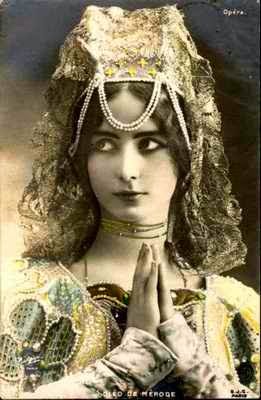
Cléo de Mérode (1875 - 1966) - Formada en la Escuela de Danza de la Ópera de París. Bailó hasta la 1º Guerra Mundial. Uno de sus espectáculos más conocidos fue en la Exposición Universal de París de 1900.
Edgar Maxence - La Fumeuse
Hector Lemaire - La Roche qui pleure - 1900
Gustav Klimt - L'arbre de la vie
Maurice Bouval - Candelabros
Lámpara Tiffany
Afiche para el espectáculo "La Dama de las Camelias" realizado por Mucha
Afiche para un baile de máscaras
Afiche de Paul Berthon
Bijou realizada por Fouquet a partir de un diseño de Mucha - ca. 1900
Peineta Bizantina realizada por Fouquet siguiendo un model de Mucha
Publicación de 1899. Diseño de Mucha
« Il faut être toujours ivre. Pour ne pas sentir l'horrible fardeau du temps qui brise vos épaules, il faut s’enivrer sans trêve. De vin, de poésie ou de vertu, à votre guise. Mais enivrez-vous ! »
Charles Baudelaire
« Nommerunobjet, c'estsupprimerlestroisquartsde la jouissancedupoèmequi estfaitedubonheurdedevinerpeuàpeu; lesuggérer, voilà lerêve. »
Stéphane Mallarmé
Post inspirado de la exposición actualmente en curso en la Pinacoteca de París sobre el Art Nouveau. Cruzando la calle, la otra exposición es la continuación de ésta: Tamara Lempicka, la Reina del Art Déco... pero esa es otra historia
Disculpas por lo terriblemente mal insertadas que estás las imágenes. ¡Uno de los grandes defectos de Blogger es la inserción de imágenes!
Nadie sueña con ser vegetariano. El vegetarianismo no inspira a nadie. Son como una especie disidente del homo sapiens, un eslabón perdido de la cadena alimenticia que, en vez de situarse heroico al final con los grandes predadores, decidió cobardemente quedarse entre los musgos y los insectos, justo por encima de la zanahoria y el brócoli. El vegetariano es la pesadilla de la anfitriona de la casa la cual queda desorientada ante tal espécimen y rápido empieza a imaginar platos a base de semillas y hojas.
¿Pero qué le vamos a servir? se cuestionan casi indignados aquellos que osan invitarlo a su mesa. Es un atentado a la moral, una falta de respeto a las buenas costumbres. Ser vegetariano es estar recluido del club de los bon vivants.
Están los militantes que enarbolan banderas verdes y defienden a todo pulmón los derechos de los cuadrúpedos. Y están aquellos que sufren en silencio, que esconden sus hábitos y no predican. Que rechazan la costilla de cerdo o se sirven ración doble de ensalada en vez de foie-gras en Navidad.
Yo los conozco, los cruzo cuando voy a los negocios de productos orgánicos. Lánguidos se pasean entre las góndolas con sus canastos llenos de productos difíciles de pronunciar. La tez mustia por la falta de proteínas animales, el pelo rebelde y las ropas sencillas. Austeridad, frugalidad que huele a abstinencia, a falta de excesos inherentes a la condición humana.
Yo los conozco muy bien. Yo soy una desde hace más de 15 años.